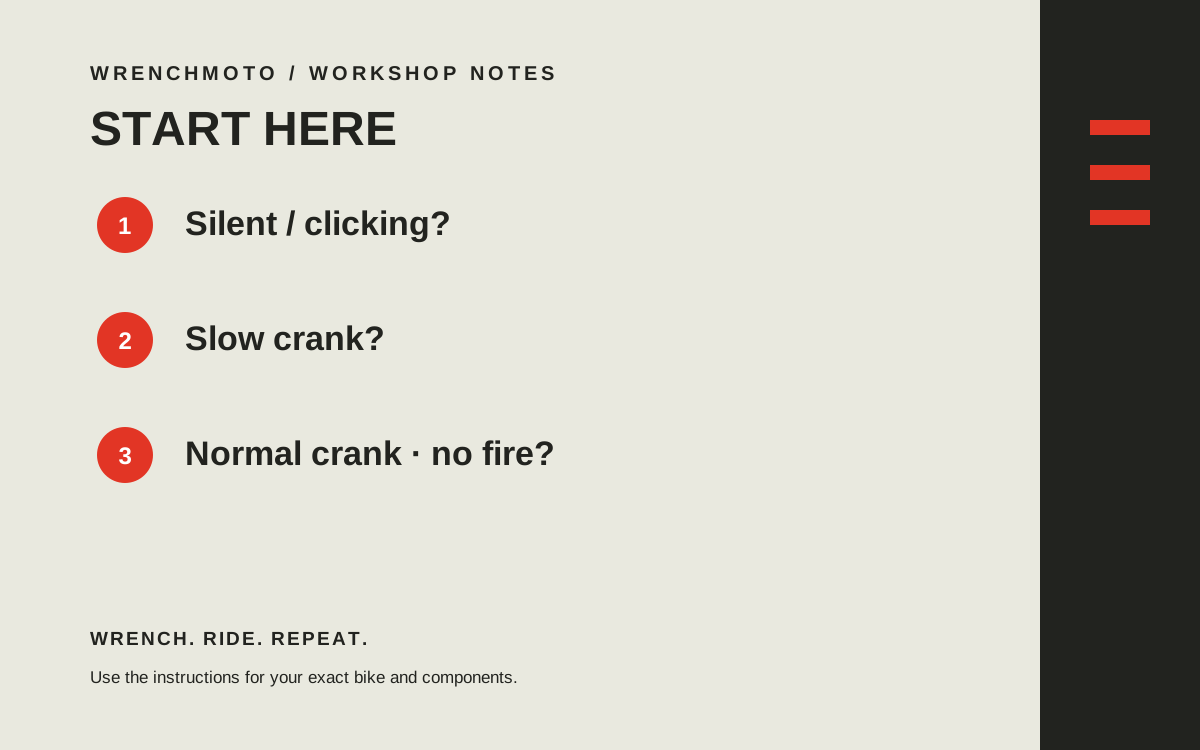
First, describe what actually happens
“Won’t start” can describe several different faults. Does an electric starter stay silent, click repeatedly, turn the engine slowly, or turn it normally without the engine firing? Write down the symptom before changing anything. This guide covers initial checks on combustion-engine dirt bikes; electric dirt bikes and high-voltage battery systems need their own manufacturer procedures.
Nothing happens when you press start
Begin with the controls and starting sequence in the owner’s manual. Yuasa notes that apparent battery trouble can come from something else, including the kill switch, fuel supply or starting interlocks where fitted. Confirm the bike’s required switch and gear positions. Do not bypass an interlock or bridge starter terminals to force a response. Tell a technician exactly which lights and sounds appear. [1]
Clicking or slow cranking
A weak battery is a possibility, not a diagnosis made from sound alone. Inspect accessible battery connections with the bike switched off, following the manual’s access procedure. If charging is appropriate, use a charger compatible with that battery’s chemistry. Yuasa explains that recurring starting trouble may require battery testing; a charge reading by itself does not establish usable starting performance. [2]
Normal cranking, but no firing
Return to the model’s starting instructions, including its cold-start procedure and any fuel valve where fitted. Confirm fuel is present and note any warning or fault indication. Stop repeated attempts at the limit in the manual. On a kick-start bike, note whether the engine turns normally and where the routine differs from its usual behavior; that information is useful even without an electric starter.
When a spark plug is part of the problem
NGK describes fouling as a cause of misfire and starting trouble. A replacement plug can be a temporary improvement while the cause of fouling remains. Use the exact specified plug and installation procedure, and record the condition of the removed part. Do not choose a different heat range merely to hide recurring fouling. Avoid exposed-spark tests around fuel during an initial driveway check. [3]
Make the next diagnosis cheaper
Keep a short record: last successful ride, recent service or washing, fuel age if known, battery type, starter behavior and any displayed code. Change one thing at a time and note its effect. If the routine checks do not resolve the problem, that record gives the workshop a clearer starting point than a box of parts replaced on suspicion.
Related reading: Foam air-filter care.
Sources & technical information
- Yuasa: starting checks and motorcycle batteries.
- Yuasa: when a motorcycle battery needs replacement.
- NGK: spark-plug basics and fouling.
Sources checked Oct 22, 2026 (UTC). Fitment, specifications and procedures vary; confirm the current manufacturer instructions for your exact bike and component.